

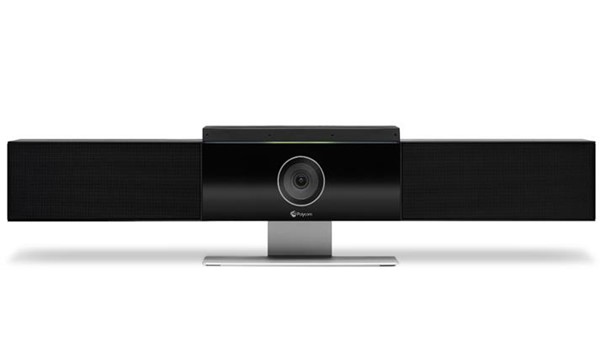
Product page: Poly Studio All-in-One Speaker, Microphone and Webcam
The Poly Studio is an all-in-one USB video bar that combines a camera, microphone array and stereo speakers in one professionally designed unit. Its purpose is straightforward: replace the untidy collection of separate webcams, table microphones, speakers and extension leads that often makes a meeting room difficult to use. For small to medium-sized rooms, the Poly Studio offers a cleaner installation and a more consistent experience than relying on the camera and microphone built into a laptop.
The camera is built around 4K Ultra HD capture, a wide 120-degree field of view and 5x electronic zoom. The wide angle is useful because it allows people seated close to the display to remain in shot without forcing the camera to be installed at the far end of the room. More importantly, Poly’s automatic group framing and speaker tracking reduce the need for manual camera control. The unit can frame the room when several people are participating and shift attention towards the active speaker. That makes remote meetings feel less static and gives people at the far end a clearer sense of who is talking.
A specification sheet never tells the whole story with video conferencing, but the Poly Studio’s feature set addresses the problems that usually matter: poor framing, distant voices, echo and distracting background noise. The six-element beamforming microphone array is designed to focus on voices and provides a pickup range of up to approximately 3.7 metres on the KPMS listing. That is suitable for a huddle room, a standard meeting room or a teaching space with participants seated within a defined area. Larger boardrooms may need the optional expansion microphone or a more substantial conferencing system.
Audio processing is one of the strongest aspects of the Poly Studio. Poly Acoustic Clarity supports full-duplex conversation, acoustic echo cancellation and background-noise suppression, allowing people at both ends to speak naturally without the system repeatedly cutting one side off. NoiseBlock technology is intended to reduce non-speech distractions, while Acoustic Fence creates a defined pickup zone so conversations outside the meeting area are less likely to intrude. These tools are particularly valuable in open offices, shared education buildings and rooms near corridors, where a conventional webcam microphone can pick up almost everything.
The integrated stereo speakers are also a meaningful upgrade over laptop audio. They are designed to fill a small or medium room, helping remote participants sound present rather than faint and distant. This matters more than many buyers expect. A high-resolution camera cannot rescue a meeting if local participants struggle to hear questions or repeatedly ask callers to speak again. By treating incoming and outgoing audio as seriously as video, the Poly Studio provides a more balanced conferencing setup.
Installation is relatively simple, although “all-in-one” does not mean completely standalone. The Poly Studio connects to a Windows PC or Mac through USB and appears to compatible meeting software as a standard camera and audio device. It works with major services, including Microsoft Teams, Zoom and Google Meet, but the computer still runs the meeting. Organisations wanting a room system that launches calls without a connected PC should consider a dedicated appliance instead.
The supplied table stand, wall mount, remote control, power adapter and USB cable provide sensible installation options, and the 700mm-wide chassis looks appropriate beneath a professional display. It is substantially larger than an ordinary webcam, but that additional size accommodates the speakers, microphone array and wide-angle camera that enable it to operate as a room product rather than a personal accessory.
Centralised administration is another advantage for organisations deploying several units. Poly Lens software can be used to configure devices, apply updates and give IT teams visibility across multiple rooms. That may be unnecessary for a single meeting space, but it becomes valuable when a school, council or company has numerous video-enabled rooms and wants consistent settings without visiting each device.
There are a few limitations to bear in mind. The Poly Studio is larger and more expensive than a normal webcam, so it is excessive for one person working at a desk. Its pan, tilt and zoom functions are electronic rather than based on a mechanically moving camera. The one-year limited hardware warranty on the KPMS listing is also less generous than the warranties attached to some commercial display products. Finally, room layout still matters: a wide-angle camera cannot compensate for poor lighting, participants sitting outside the microphone zone or a display mounted in an unsuitable position.
For the intended setting, however, the Poly Studio is a strong and mature solution. It simplifies the room, improves audio intelligibility, provides intelligent framing and remains compatible with the conferencing platforms organisations already use. Its greatest strength is not any single headline number; it is the way the camera, microphones, speakers and noise-management technologies work as one package.
Businesses and education providers that run frequent hybrid meetings should find the Poly Studio a substantial improvement over improvised laptop-based setups. It is particularly appealing for organisations that want better meetings without committing to a complicated or platform-specific room system.